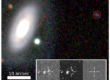
Einstein’s General theory of Relativity predicted that massive galaxies could act as a gravitational lens for objects directly `behind’ it. Depending on its exact orientation, multiple images could be seen around an arc centered on the foreground galaxy. In 1964, Sjur Refsdal suggested that supernovae could be lensed by a foreground galaxy and might be seen as two different sources. Observations of the lensed supernova could be used to determine the mass of the lensing galaxy and infer the Hubble Constant. The first supernova lensed into multiple sources wasn’t seen until 2014 with others detected since.
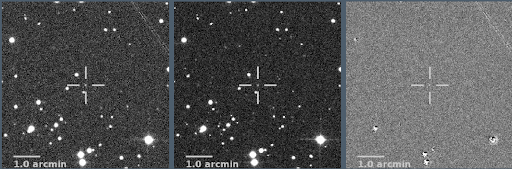
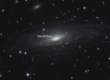
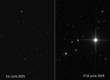
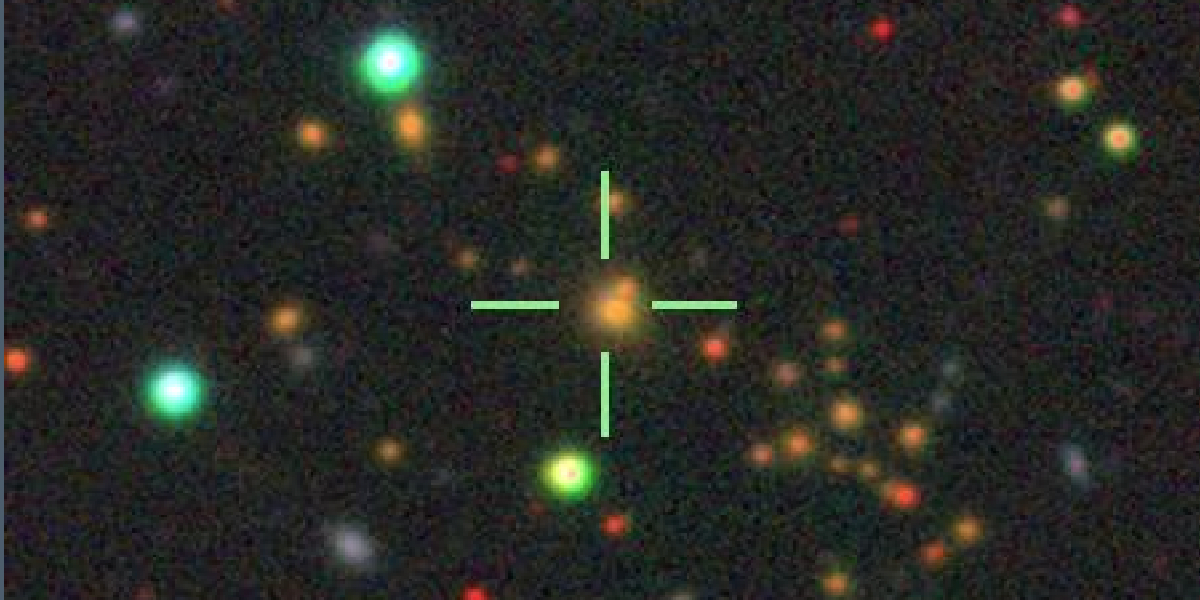
On 1st Sept 2025 GOTO reported a new transient source, GOTO25gqt, to the Transient Name Server (TNS), a few hours after being detected. On 4th Sept, ZTF reported the same event, ZTF25abnjznp, which they detected on Aug 27th. On Sept 4th, a team reported observations made using the Liverpool Telescope that they detected three new sources around a galaxy and suggested they were all due to the same supernovae event – i.e. it was a lensed supernova with multiple sources.
A team led by Joel Johansson have now reported further observations of this lensed event and find that the lensing galaxy was at a redshift of z = 0.3754 with the supernova being at a redshift of z=2.01. They conclude that this supernova was the first gravitationally lensed Type I superluminous supernova. We look forward to finding more lensed supernovae using GOTO! The paper which Joel led can be found here.